

Recently, someone I respect mentioned that a part of a page on my website looked like it could have been written by AI. The “tell” was em-dashes.
The feedback was kindly meant, and I appreciated it. (For the record, I’ve been abusing em-dashes long before AI came along.)
But it got me thinking about something much bigger than my punctuation habits.
We’re building an AI-use-shaming culture during the golden age of AI technology. That seems a bit tone deaf.
Seriously. We’re in the middle of one of the biggest technological shifts in decades, and people are scanning for em-dashes like they’re counterfeit bills.
It’s 2026. Using AI well is a skill, not a shortcut.
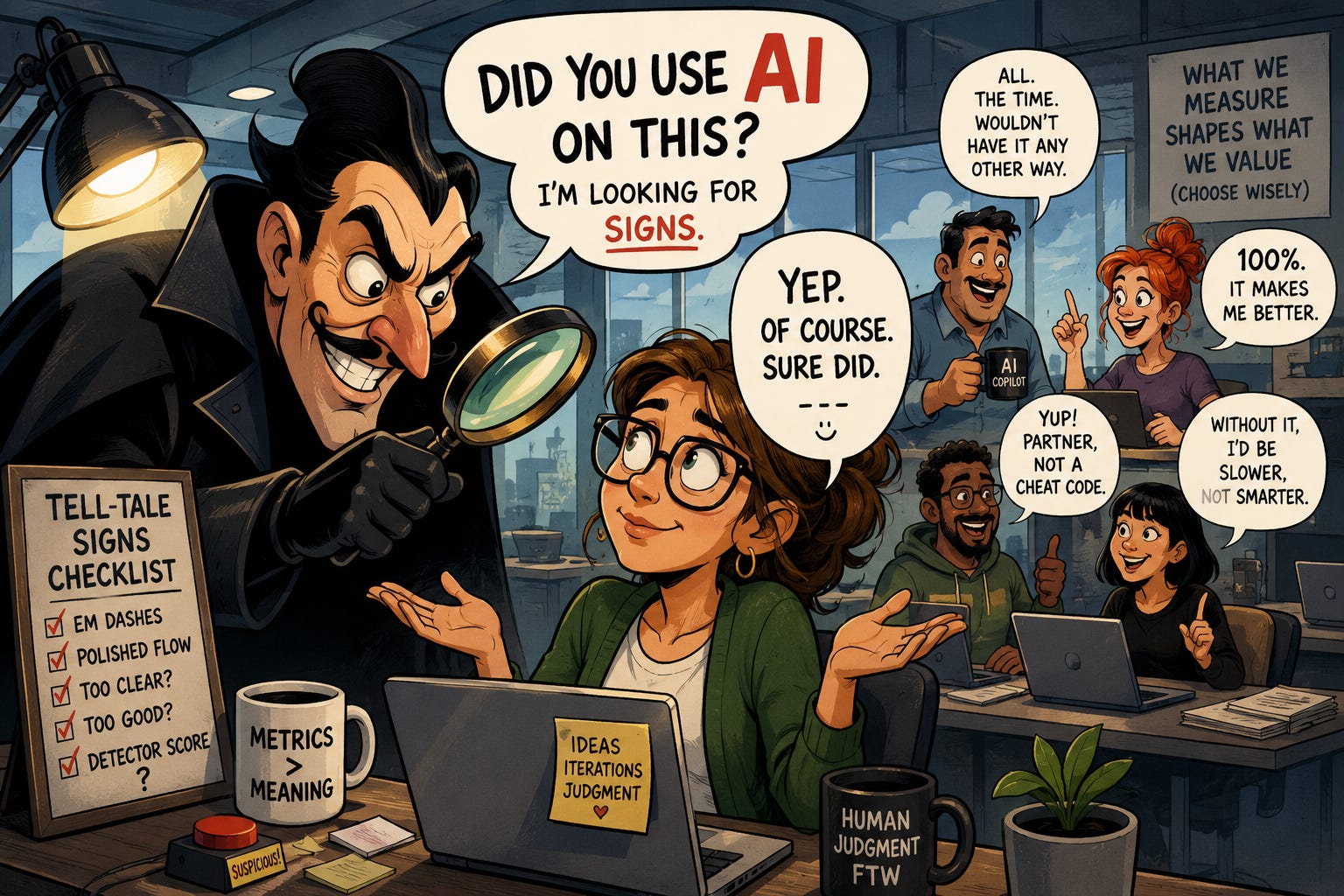
If someone is NOT using AI to push their thinking further, stress-test ideas, iterate faster, and improve the quality of their work, that’s the bigger concern.
The question is not “did AI touch this?”
The question is: did a human with judgment drive this?
And I get it. That’s a much harder thing to measure.
Which means, once again, we’re defaulting to the easy metric.
What we measure shapes what we value. And eventually, what we build.
We’ve done this before.
We measured clicks when we should have measured engagement. Page views when we should have measured value. Adoption rates when we should have measured outcomes.
Eventually, we realized the easy metric was the wrong metric. But not before we wrote off real value that we couldn’t see.
I worry we’re doing it again.
So what should we measure instead?
I’m honestly not sure.
It’s a lot like teamwork. The things that matter most are often the hardest to measure well. Team health. Trust. Judgment. Customer confidence. You can approximate some of it through NPS scores or 360 reviews, but neither fully captures what’s actually happening.
Human-AI collaboration feels similar to me. The qualities that matter most are harder to measure than whether someone used an em-dash.
But just because something is difficult to measure doesn’t mean we can afford to measure it badly.
Where did the idea originate? How many rounds did the work go through? What got pushed back on, rewritten, or thrown out? Who decided when it was done, and what quality bar did they hold?
I know this firsthand. My AI partners regularly signal that something is “ready to go” while I keep editing, rethinking, and pushing. I don’t stop until the work is mine. Better than I could have done on my own, but mine.
The gap between a first draft and a final product is where our human judgment lives. And no punctuation scan can capture it.
Instead of AI-use detection, what if we focused on AI-collaboration literacy? Can someone articulate how they worked with AI? Can they explain what they brought versus what the tool brought? Can they show the evolution of the work?
Instead of shaming people for using the most powerful creative and analytical tool of our generation, let’s celebrate the people who use it with rigor, transparency, and high standards.
If we reward people for hiding AI instead of using it thoughtfully, we’re going to train exactly the wrong behaviors. Worse, we’re teaching people to resist the very tools that could expand their creativity, growth, and impact.
That’s not a recipe for progress.
💬 Are we rewarding thoughtful AI collaboration… or just rewarding people who are better at concealing it? What’s your take?
One more thing.
I know this is hard.
If you’re a manager trying to evaluate your team’s work, a professor grading papers, or a teacher figuring out what’s original and what isn’t, I’m not pretending this is simple.
That may mean asking people to show their work again. To explain their thinking. To demonstrate iteration, refinement, and reasoning.
The way math teachers used to ask us to show our work, not just circle the answer.
But I hope we can agree on one thing:
Pretending the problem of measuring human-AI collaboration is already solved is far, far more dangerous than admitting we’re still figuring it out.
Written by Maura Randall | I write about product, leadership, and using AI as a true teammate — not a replacement — while juggling all the realities of modern adulting. Bonus: I share ways AI can help with the messy parts of life, too.
Great topic and thoughtful post. I use a set of skills to scrub the standard AI style out of my AI-enabled writing. Partly because I don’t want my work to ‘scream AI’ but mostly because standard AI output isn’t good writing. Overly simplified ideas showing a lack of lived experience make up so much of what the torches and pitchforks are attacking. That’s your point — those who use AI well and apply judgement are unlocking the value.
This is such an interesting topic. It seems like people think using AI is similar to plagiarism, or it’s an issue of authenticity. But either way, your article makes the point that it’s neither, if the person is using their judgment and driving the work.
For the record, I used to use em dashes constantly. But I’ve had to change my writing style because I’m so fearful that people will think AI wrote it for me.